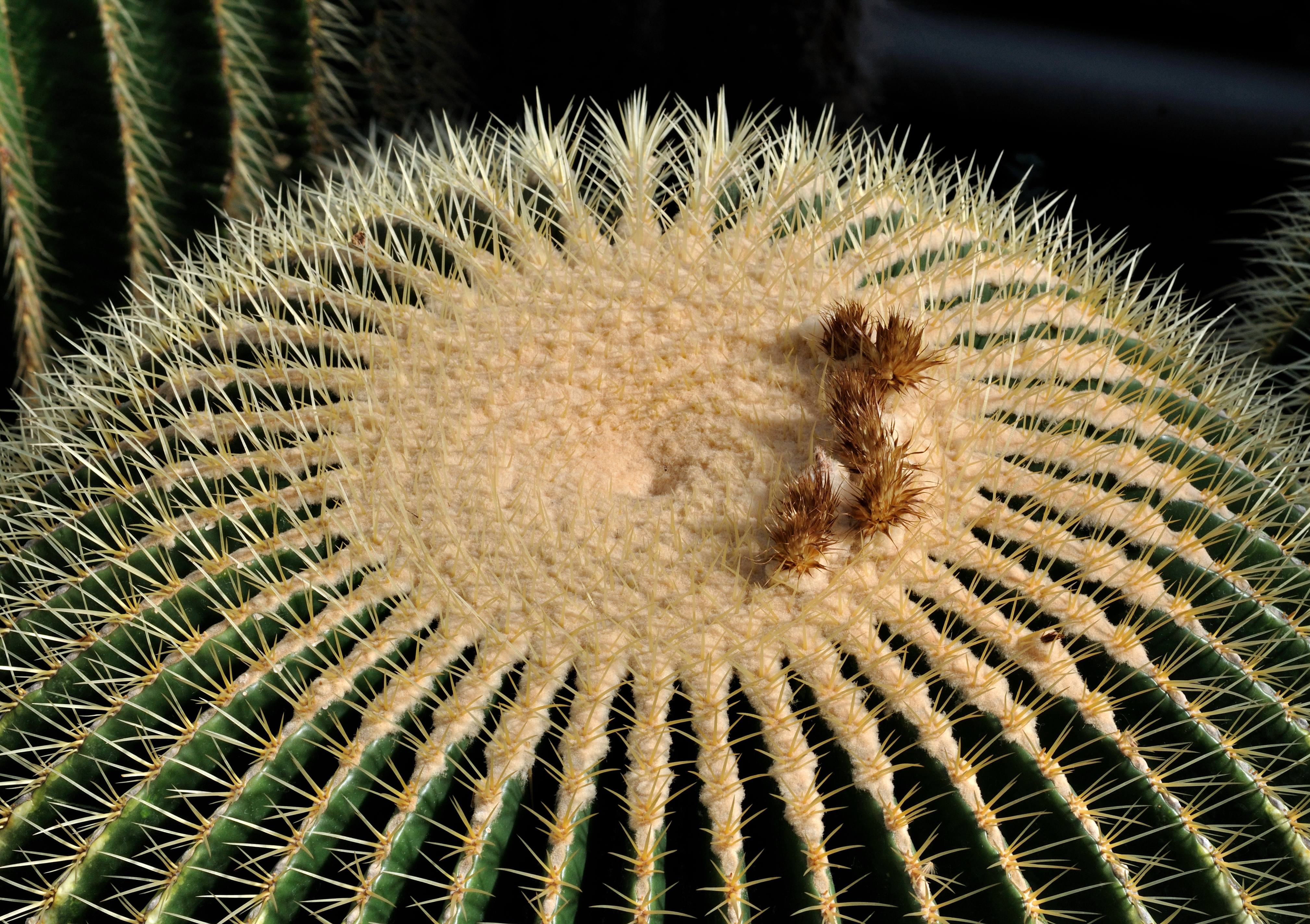
Golden Barrel Cactus
Quick Facts & Botanical Stats
Species Overview
What is the Golden Barrel Cactus? The golden barrel cactus (Echinocactus grusonii), or mother-in-law's cushion, is a globular cactus in the Cactaceae family. Native to the deserts of Central Mexico, it is famous for its spherical shape and dense covering of bright yellow spines. Is it endangered? Yes, while it is one of the most popular cultivated cacti globally, it is critically endangered in the wild due to habitat flooding from dam construction.
Physical Appearance & Anatomy
What does a golden barrel cactus look like? The plant is spherical, becoming slightly columnar as it reaches maturity. The stem is bright green and has up to 35 pronounced vertical ribs. Why are its spines yellow? The ribs are lined with woolly areoles that produce long, stiff, golden-yellow spines. In summer, mature cacti (over 20 years old) produce a crown of small, cup-shaped yellow flowers at the top.
Habitat & Growth Behavior
Where do golden barrel cacti grow? They grow in rocky limestone and volcanic soils on steep desert slopes. They require full, intense sun and minimal moisture. How do they adapt? The spherical shape minimizes surface area to reduce evaporation. The pleats (ribs) allow the stem to swell to store water after rare desert rains. The dense network of yellow spines shades the skin, preventing sunburn.
Ecological Role & Symbioses
What is the ecological role of the golden barrel? The flowers provide pollen and nectar for desert bees. Are they eaten by animals? The heavy armor of sharp spines prevents desert mammals from eating the fleshy stem. In hot deserts, they protect small lizards that hide between the spines. In landscaping, they are used as dramatic accents.
Reproduction, Lifecycle & Propagation
Golden barrel cacti reproduce sexually. Bees pollinate the yellow flowers, which develop into woolly, seed-filled fruits. The seeds are dispersed by rain and wind. Sown seeds grow slowly: a 10-year-old plant may be only the size of a tennis ball. They reach reproductive maturity around 20 to 30 years of age and can live for up to a century.
Conservation Status & Environmental Threats
Echinocactus grusonii is listed as Endangered on the IUCN Red List. In the 1990s, the construction of the Zimapán Dam flooded much of its primary wild habitat in Querétaro. Today, wild populations are small and protected. Poaching for the exotic plant trade remains a threat, though commercial nursery cultivation is massive.
Interesting Fun Facts
- The golden barrel cactus is nicknamed 'Mother-in-law's cushion' due to its spherical shape and prickly surface.
- While extremely common in gardens and nurseries worldwide, it is critically endangered in its native Mexican wild habitat.
- The plant must be at least 20 to 30 years old before it produces its first yellow flowers at the crown.
- The cactus naturally leans toward the south or southwest as it grows, which helps protect its sensitive growing tip from sunburn.
Related Plants

Saguaro Cactus
Least ConcernWhat is a Saguaro Cactus? Carnegiea gigantea, the saguaro, is a massive, tree-like cactus species belonging to the Cactaceae family. It is the iconic symbol of the American Southwest and is native exclusively to the Sonoran Desert. Growing slowly over two centuries, the saguaro develops a thick, ribbed trunk and characteristic branching arms. Saguaros are keystone species in their desert ecosystem, providing nesting sites, moisture, and food for dozens of desert animals.
Prickly Pear
Least ConcernWhat is a Prickly Pear? The prickly pear (Opuntia ficus-indica), or nopal, is a large, shrubby cactus in the Cactaceae family. Native to Mexico, it has been cultivated for thousands of years for its edible pads (nopales) and sweet fruit (tunas). It is famous for its flattened, paddle-like stem segments. It has naturalized globally, becoming invasive in some arid regions of Australia and Africa.