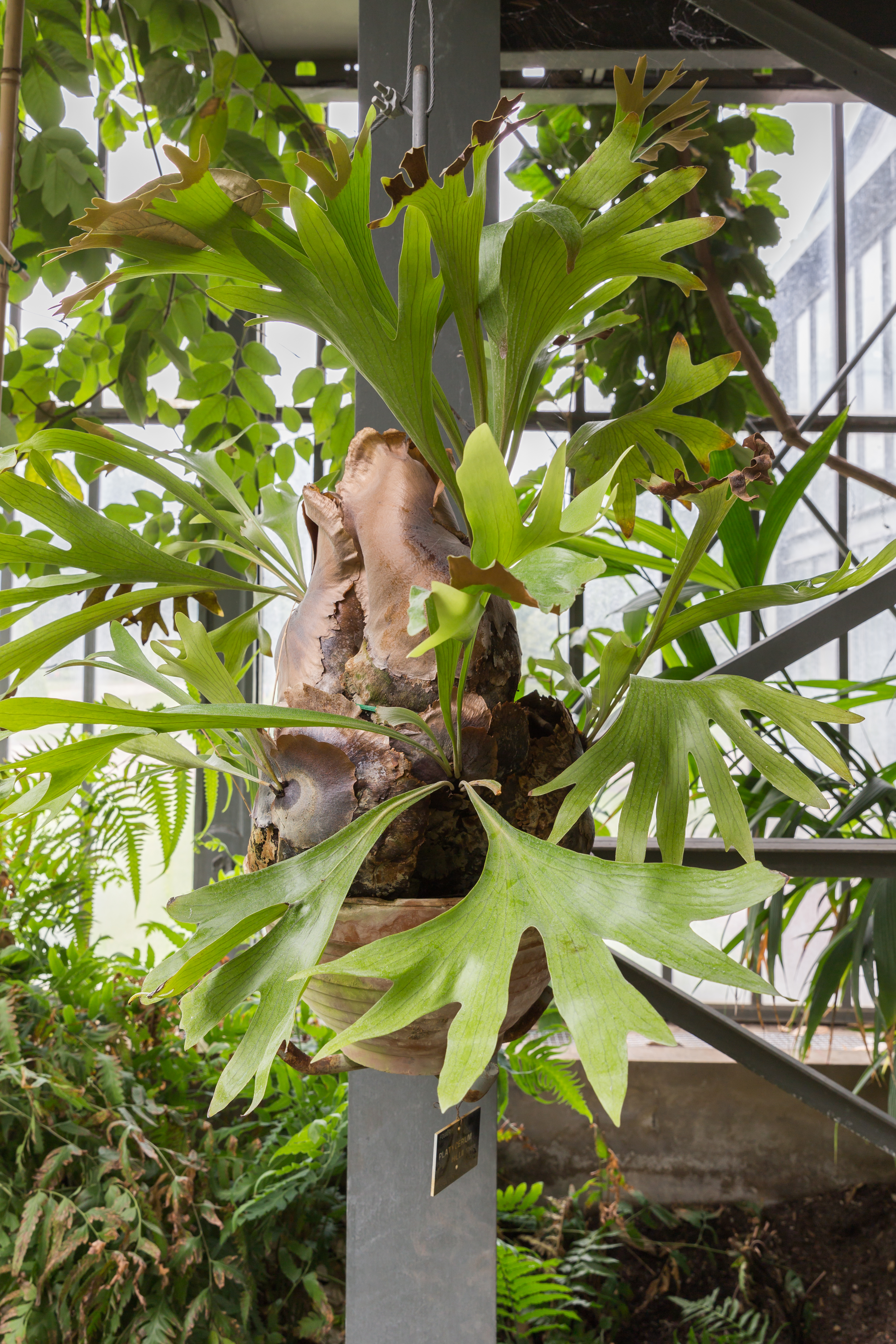
Staghorn Fern
Quick Facts & Botanical Stats
Species Overview
What is a staghorn fern? The staghorn fern (Platycerium bifurcatum) is a unique epiphytic fern in the Polypodiaceae family. Native to tropical rainforest canopies, it does not grow in soil; instead, it grows anchored to the bark of trees. It is named for its large, antler-like fronds. What are the two types of leaves on a staghorn fern? It is dimorphic, producing flat, round shield leaves at the base and long, branching fertile leaves.
Physical Appearance & Anatomy
What does a staghorn fern look like? The fern grows in massive clumps on trees. How do its two leaf types function? The base consists of flat, circular, sterile shield leaves that start green and turn brown, wrapping around the host tree to collect falling leaves and debris for nutrients. From the center grow long, arching, strap-like fertile leaves that branch at the ends, resembling deer antlers, coated in fine silver hairs.
Habitat & Growth Behavior
Where do staghorn ferns grow? They grow in tropical rainforests under the shade of the canopy. How do they get water? They absorb moisture from rain, humidity, and dew through their leaves. The shield leaves form a basket that traps organic debris and rainwater, composting it to feed the roots. The silver hairs on the fertile fronds help trap water droplets and prevent moisture loss in dry periods.
Ecological Role & Symbioses
What is the ecological role of the staghorn fern? Because they form massive, heavy baskets high in trees, they create suspended soil islands that shelter frogs, insects, lizards, and nesting birds. Are they parasites? No, they are epiphytes; they use trees solely for physical support, obtaining all nutrients from rainwater and decaying canopy debris.
Reproduction, Lifecycle & Propagation
Staghorn ferns reproduce via spores. In late summer, they produce dense, brown, felt-like spore patches (sporangia) on the tips of the antler-like leaves. Wind carries the spores, which germinate on damp, mossy tree bark. Vegetatively, they propagate by producing small offsets, called 'pups', from their root systems, which grow to form massive colonial clumps over decades.
Conservation Status & Environmental Threats
Platycerium bifurcatum is classified as Least Concern on the IUCN Red List. It is cultivated globally. Wild populations in Australia are protected, though logging of host trees and illegal harvesting of large specimens present localized threats. They are highly popular ornamentals, often mounted on wooden boards for wall displays.
Interesting Fun Facts
- Staghorn ferns produce two leaf types: flat, round leaves that form a basket to collect compost, and branching leaves that look like deer antlers.
- In the wild, they grow high in rainforest trees without soil, absorbing water from the air and nutrients from falling forest debris.
- Over decades, colonial clumps of staghorn ferns can grow to weigh over 100 kg (220 lbs), sometimes breaking the tree branches holding them.
- The leaf tips are covered in fuzzy, silver-white hairs that help the plant trap moisture and protect it from sun glare.
Related Plants

Boston Fern
Least ConcernWhat is a Boston fern? The Boston fern (Nephrolepis exaltata 'Bostoniensis') is a popular species of fern belonging to the Lomariopsidaceae family. Native to humid, tropical woodlands and swamps, it is globally famous for its lush, arching, feathery fronds. Discovered in a shipment of ferns from Boston to Philadelphia in 1894, it became a classic Victorian houseplant. Like all ferns, it is a non-flowering vascular plant that reproduces via spores rather than seeds.

Moth Orchid
Least ConcernWhat is a moth orchid? The moth orchid (Phalaenopsis amabilis) is an epiphytic perennial plant belonging to the Orchidaceae family, one of the two largest families of flowering plants. Native to the warm, humid rainforests of Southeast Asia, it grows attached to the bark of trees rather than in soil. Known for its elegant, long-lasting flowers that resemble moths in flight, it is highly popular as an indoor houseplant and is a national flower of Indonesia.